
How to Manage Attendance of Construction Workers Across Multiple Job Sites


Tracking employee attendance is straightforward when everyone works in one office.
Construction companies face a different challenge.
Employees may be assigned to different project sites, report directly to the field, or move between locations. For HR teams, collecting attendance records from a distributed workforce can make timekeeping, DTR preparation, and payroll processing more difficult.
So, how can construction companies track employee hours without relying entirely on paper records, spreadsheets, or fixed biometric machines?
Why Attendance in Construction Is Different
Traditional attendance methods are usually designed for fixed workplaces.
A fingerprint machine at the main office may work well for office employees, but it becomes less practical when workers are assigned to several construction sites. Installing and maintaining separate devices at every location can also add unnecessary equipment and administrative work.
Manual DTRs and spreadsheets have their own challenges. Attendance records may need to be collected from supervisors, encoded, checked, and consolidated before HR can use them.
As the number of employees and project sites grows, these processes can become harder to manage.
What an Attendance System in a Construction Industry Should Provide
For construction companies, attendance is not just about recording when an employee clocks in. A useful system should help answer:
Who is clocking in? When did they clock in? Where did they clock in?
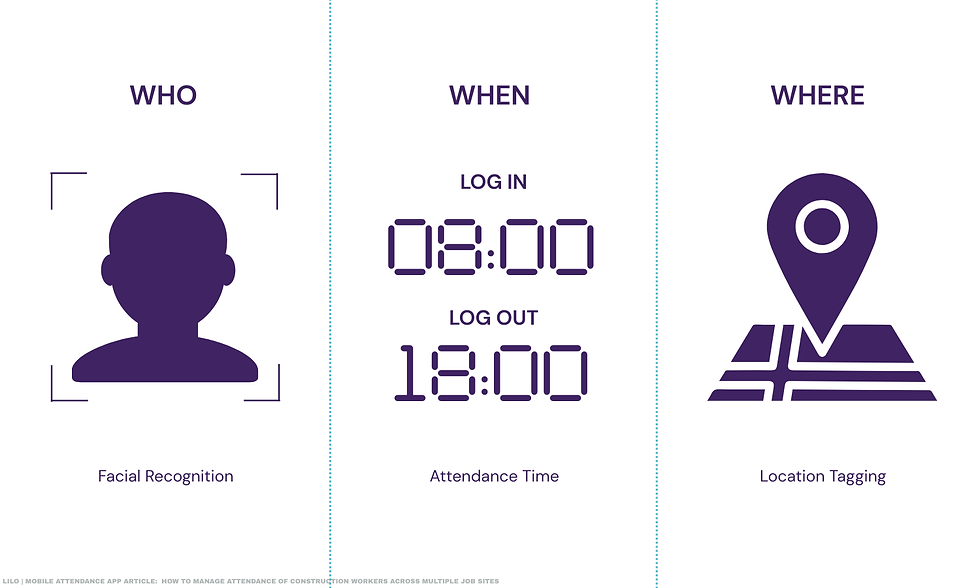
These needs call for an attendance system that can adapt to the realities of working across different project sites.
Facial recognition can help verify that the employee recording attendance is the actual employee assigned to the shift, helping reduce buddy punching.
Location tagging can provide visibility into where the attendance was recorded, which is especially useful when employees are assigned to different project sites.
Mobile attendance app allows employees to record their time using a smartphone instead of depending on a fixed biometric machine.
Offline functionality is also important for construction sites where internet connectivity may be unreliable. Employees can record attendance while offline and synchronize the information once connectivity is restored.
Together, these features make timekeeping more suitable for a workforce that doesn't stay in one place.
Making Attendance Management Easier
Digital attendance can also reduce the administrative work involved in managing DTRs.
Instead of collecting separate attendance records from different project sites, HR can access attendance information through a centralized system. This can make it easier to review attendance, identify missing records, and prepare information needed for payroll.
The goal isn't simply to replace a punch card or biometric machine.
It's to give HR and managers a clearer view of who worked, when they worked, and where they worked.
How LILO Supports Attendance in the Construction Industry
LILO is a mobile attendance app and online attendance system designed for office, remote, and field employees.
For construction teams, LILO combines facial recognition, liveness detection, and location tagging to help verify employee identity and attendance location. Employees can record attendance using a smartphone or computer, while offline functionality helps keep attendance recording available even when connectivity is limited.
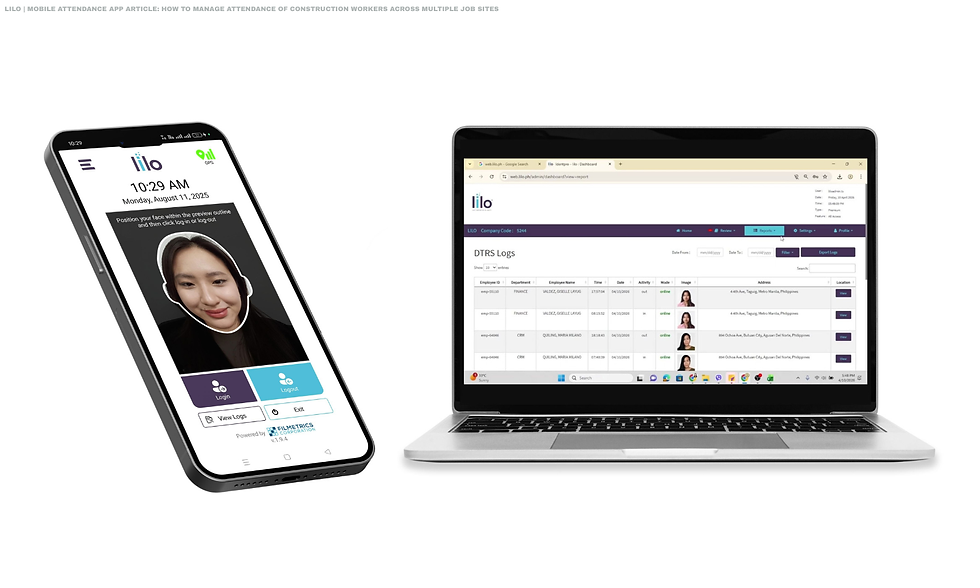
This gives construction companies a way to manage attendance across different project sites without relying entirely on paper DTRs, spreadsheets, or physical biometric machines.
Attendance in the Construction Industry Should Fit the Way Your Workforce Works
Construction workers/employees don't always work in one place, so attendance management shouldn't be limited to one place either.
A modern attendance system should make attendance easier to record, verify, and manage across project sites while giving HR the information they need for DTR and payroll processes.
LILO helps construction companies manage employee attendance across locations with facial recognition, liveness detection, and location tagging, all in one system.



Comments